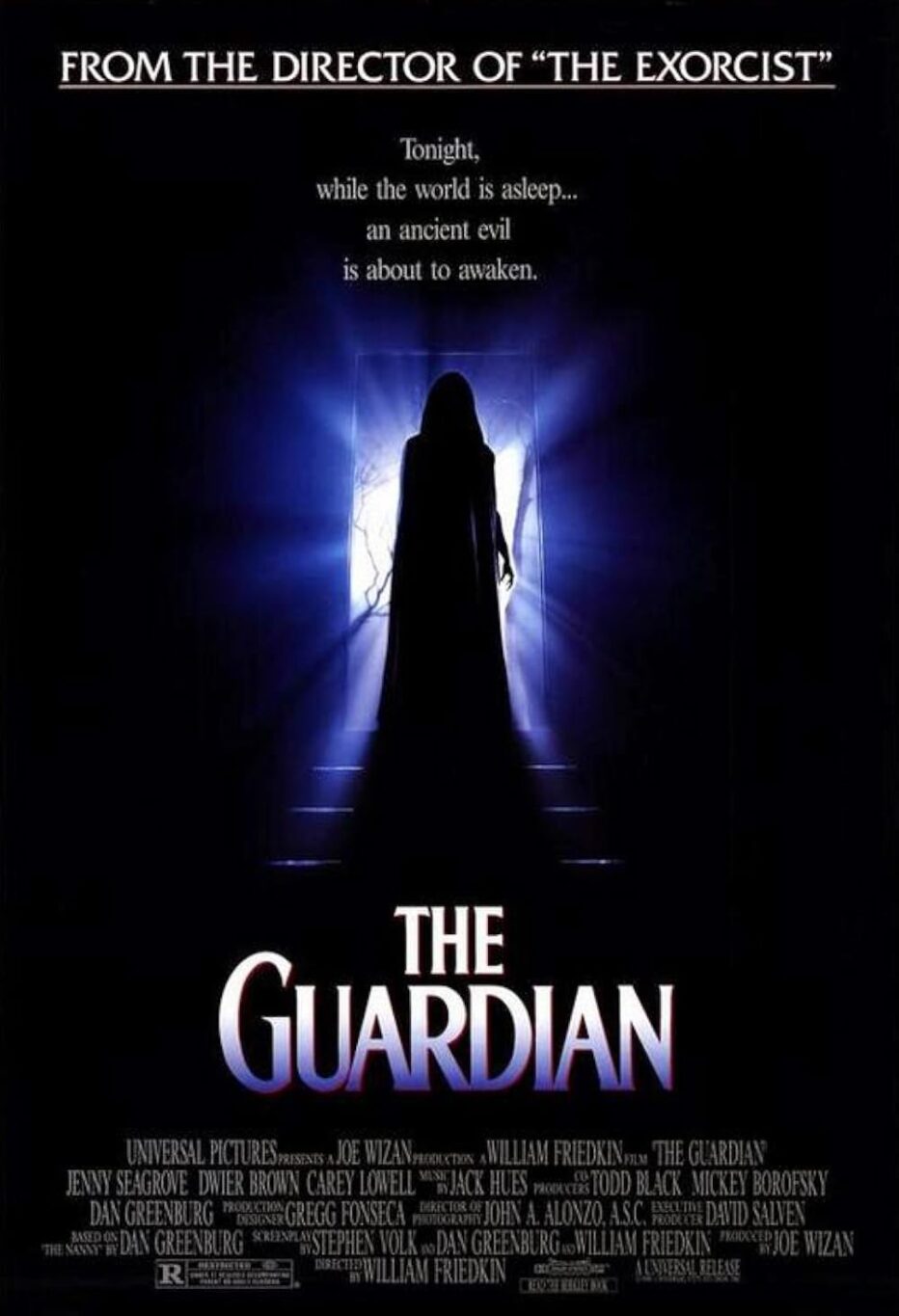
The Guardian (1990) Review
The Guardian (1990) Review
By the close of the Eighties, American horror had become increasingly tiresome and formulaic. Genuine chills were being replaced by ever more elaborate splatter sequences, with inventive deaths taking precedence over plot and character development. Meanwhile, several long-running franchises had exhausted whatever goodwill audiences still had to offer.
Into this increasingly stale cinematic landscape stepped William Friedkin, returning to horror following the phenomenal success of The Exorcist (1973). Unfortunately, rather than delivering a much-needed breath of fresh air, The Guardian proved an altogether more frustrating experience. Friedkin clearly wanted to move away from disposable shocks in favour of atmosphere and ambiguity, but his film demands a gargantuan suspension of disbelief from an audience left struggling to fill in the gaps of a script that seems determined to explain almost nothing.
There is a certain boldness in refusing to spoon-feed viewers, particularly in an era increasingly accustomed to multiplex-friendly storytelling. However, The Guardian manages to do precisely that in all the wrong places while withholding information where it matters most. Its opening prologue practically lays out everything audiences can expect over the following ninety minutes. It is an unnecessary scene that robs the film of any meaningful element of surprise. Horror should unsettle its audience, not hand them a preview of what lies ahead.
Young American couple Phil (Dwier Brown) and Kate (Carey Lowell) have recently welcomed a baby boy, Jake, into their lives. For reasons that are never particularly clear, they require a nanny, and after their initial choice meets a sticky end, they settle on Camilla (Jenny Seagrove).
Camilla quickly becomes part of the family, fitting in so comfortably that nobody seems particularly troubled by her habit of bathing naked or towelling herself down in front of Jake’s father. Then again, Phil spends much of the film wandering around with less clothing than a Baywatch extra, so perhaps Camilla simply assumes this is how Americans behave. Kate, meanwhile, appears entirely unbothered by the proceedings and contributes remarkably little to the story, making her feel more like an afterthought than one half of the supposedly central couple.
When their friend and neighbour Ned Runcie (Brad Hall) takes a shine to Camilla, matters begin to deteriorate. It soon becomes apparent that the seemingly devoted nanny has a rather unpleasant agenda, one involving feeding baby Jake to a sinister-looking tree that conveniently materialises wherever Camilla happens to find herself in America. Childcare has rarely been quite so complicated.
A monumental disappointment on its original theatrical release, The Guardian has apparently acquired something of a cult following over the years. There really is no accounting for taste.
The elevation of films such as The Wicker Man (1973) and Don’t Look Now (1973) to cult status is entirely understandable, given their artistic merits and the circumstances surrounding their initial commercial failures. With The Guardian, however, one can only assume its devotees are either a band of particularly committed Druids or college students who believe the film is best appreciated through a haze of cheap alcohol.
The excellent disc extras offer some clues as to why the finished film fails to live up to its potential. On one side, there is Friedkin, returning to the genre that delivered his greatest success and apparently still convinced that his reputation afforded him carte blanche. On the other, screenwriter Stephen Volk, whose experience working on the production ultimately became so fraught that he walked away from the project.
Having listened to Friedkin’s interviews across the various home-entertainment releases of The Exorcist, it is difficult not to find the behind-the-scenes accounts illuminating. Brash, aggressive and unapologetically opinionated, Friedkin comes across as a filmmaker who could dominate a production to the detriment of those around him. His demands and subsequent script revisions appear to have played a significant part in derailing what might otherwise have been an entertaining horror romp.
Volk was arguably right to distance himself from the chaos. His original adaptation of Dan Greenburg’s novel The Nanny was conceived as a comedy horror, and the finished film occasionally hints at the mischievous entertainment that might have emerged under different circumstances.
Jenny Seagrove is unquestionably the film’s greatest asset. As Camilla, the nanny with designs on the couple’s newborn, she brings an unsettling calm to a role that could easily have descended into pantomime. As Seagrove herself acknowledges in the extras, the camera loves her, and she barely needs to break a sweat. Her fixed stare and wonderfully plummy British accent generate more genuine unease than much of the screenplay manages to muster. She is a deliciously sinister presence in an otherwise rather muddled affair.
With chainsaws, supernatural shenanigans and a decidedly mobile tree, it is easy to understand why Universal initially approached Sam Raimi, director of The Evil Dead (1981), to helm the project. Given Raimi’s penchant for outrageous physical comedy and gleefully excessive gore, the original comedy-horror concept could have been a natural fit. One can readily imagine Bruce Campbell wielding a chainsaw during the climax, had Raimi remained attached.
Unfortunately, Universal presented Raimi with a choice between The Guardian and Darkman (1990). He opted for the latter, leaving the studio to bring Friedkin aboard in the hope of replicating the box-office phenomenon of The Exorcist. That particular gamble failed to pay off. Once Friedkin took charge, the original concept was subjected to revisions and competing creative demands, leaving the finished film feeling less like a coherent vision and more like a collection of ideas fighting for dominance.
To be fair, The Guardian is better than its reputation might suggest, but that is hardly the same as being good. It remains an uneven, frequently frustrating film, and an ending that feels like one too many only adds to the sense of a production unsure when to call it a day. Perhaps test-screening audiences demanded a little more spectacle, but the additional material does little to improve the overall experience.
Most frustrating of all is the knowledge that a more straightforward approach might have yielded something considerably better. Seagrove reportedly suggested to Universal that the film should concentrate on the simple but effective premise of an evil nanny, rather than complicating matters with its Druid mythology. The studio apparently felt such a concept would not appeal to audiences or prove sufficiently profitable.
Just two years later, The Hand That Rocks the Cradle (1992) became a major box-office success with precisely that premise: an evil nanny infiltrating a family’s home. The irony is almost painful.
Had Universal listened to Seagrove and Volk, and resisted allowing Friedkin to reshape the project to such an extent, The Guardian might have emerged as the deliriously entertaining horror comedy it occasionally threatens to be. Instead, we are left with a scrambled mishmash of supernatural folklore, misplaced seriousness and squandered potential. The tree may have roots, but this film never quite finds its footing.