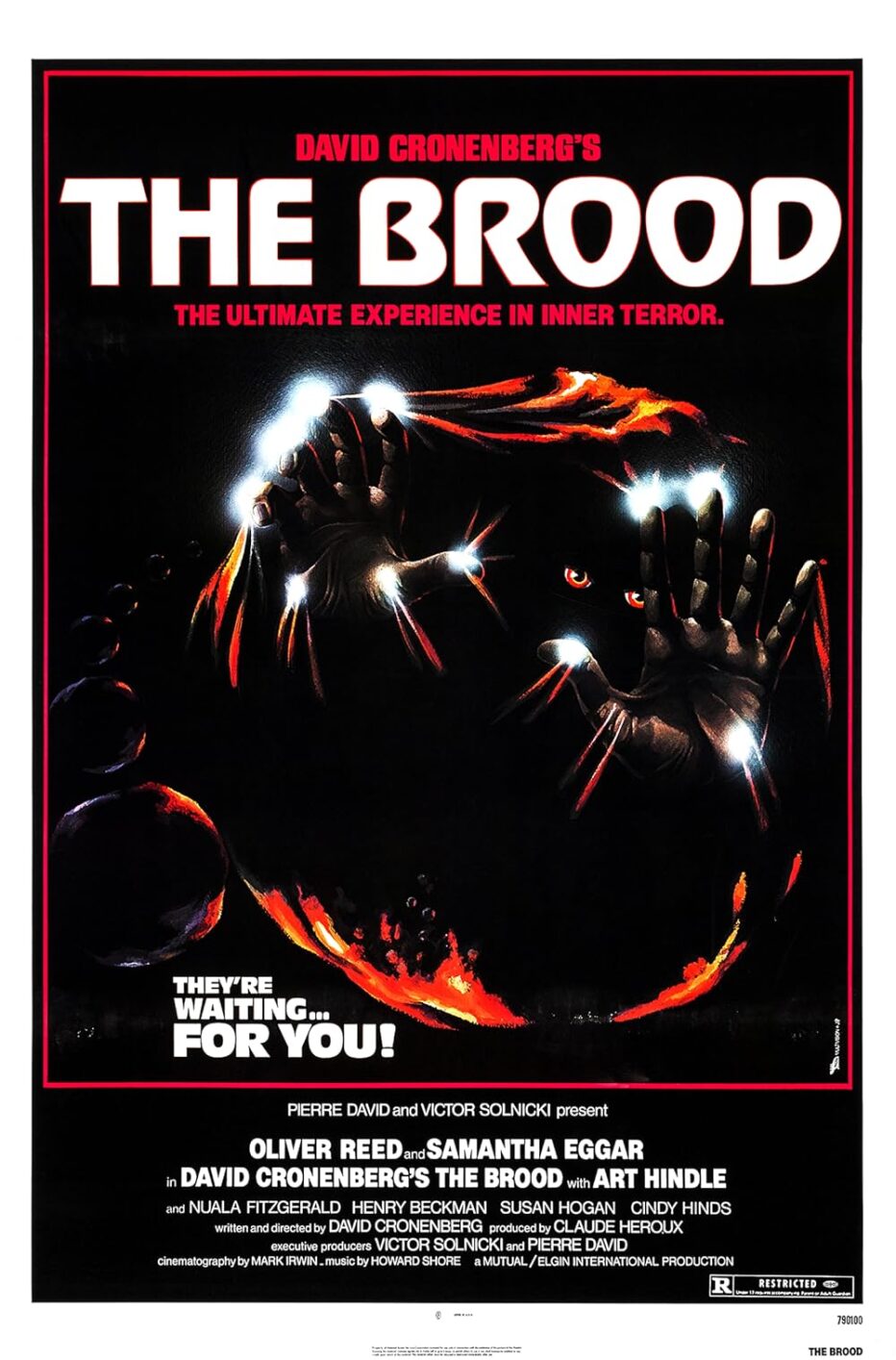
The Brood (1979)
They say that when it comes to writing, always write what you know, and that’s exactly what Cronenberg did with the Brood, his fourth feature film. In penning a film where mutant children attack anyone that their mother feels anger towards, Cronenberg drew upon his bitter child-custody battle, against his ex-wife, for his daughter Cassandra.
He considered his ex-wife unstable and was less than thrilled when she announced that she would be relocating, with their daughter, to California. To stop this from happening, Cronenberg took his daughter from school on the same day whilst ensuring a court order had been filed preventing his ex-wife from leaving with Cassandra as planned.
By lifting dialogue from actual arguments he’d had with his ex-wife, Cronenberg pulled the breaks on a script he had been working on about a war between psychics and shaped his bitter child-custody experience into The Brood. Securing his largest budget to date Cronenberg was able to get name actors Oliver Reed and Samantha Eggar cast. The resulting film has been considered by many critics as a transitional point for the director, seeing him mature from his B-movie roots, Shivers and Rabid whilst still providing decent shocks too.
Art Hindle (star of the original Black Christmas and 1978’s Invasion of the Body Snatchers) stars as Frank. His institutionalized wife Nola (Samantha Eggar) is receiving unconventional therapy from the equally unconventional Dr. Raglan (Oliver Reed) called psychoplasmics to assist with releasing his patients’ suppressed emotions. Frank, and the very disturbed Nola, are battling for legal custody of their young daughter Candice (Cindy Hinds)
Upon picking up Candice following her visit to see Nola he notices bruises and scratches on her back as he attends her. Naturally concerned and outraged he advises Dr. Raglan that his daughter will not be visiting his mother at the institute again. Raglan is concerned that this will impair the progress and work that he has been conducting with Nola but Frank won’t be swayed into changing his mind.
It soon becomes very clear that when Nola becomes enraged that the individual she is angry towards meets an unexpected and violent death soon after. The murders are being committed by short, odd-looking children not big on speaking a lot but very handy when it comes to smashing someone’s head right in. But who are these freakish-looking children and where do they come from? Frank’s investigation ends with a bloody and shocking climax at Raglan’s Somafree Institute that after all these years still has the power to be profoundly disturbing.
Oliver Reed, no stranger to the horror genre with his The Curse of the Werewolf and Burnt Offerings turns in a solid performance graced with his customary quiet, almost whispery voice. He was one of those actors who could say more with a glance adding an undercurrent of menace to his performance. Samantha Eggar, who described making The Brood as the strangest experience of her career, captures Nola’s disturbed persona and helps pull off THAT scene at the story’s end by making the unbelievable play as if real.
Second Sight have come up with some rather wonderful extras for their release of The Brood, however the promise of Meet the Carveths, an opportunity to listen to Art Hindle and his The Brood on-screen daughter Cindy Hinds reflect on their experience of working on Cronenberg‘s movie. Art Hindle has proved before that he is a fun interviewee and even turned in a decent co-hosting of an extra on the original Black Christmas. Here, both Hindle and his co-star Hinds are hampered by the awkward interview set-up courtesy of Fangoria editor Chris Alexander.
The set-up for the interview uses the standard cliché of having film stars interviewed in an auditorium, all with large bags of popcorn, with which Hinds looks hugely uninterested, Alexander is often facing away from those he is interviewing and looks to have his back to Hinds. It’s embarrassing to watch and an insult to Hinds who is kind of cold-shouldered out. Both actors look far more comfortable when they are back at the school featured in The Brood and it’s nice not to have to look at Chris Alexander‘s smarmy face. As Art Hindle proved on the original Black Christmas extras that he has enough spark and verve to make for an entertaining host, perhaps they should have let him run with it instead.
One common theme in the disc‘s extras, aside from obviously recollections about working on The Brood, are tales about working with the infamous Oliver Reed, the main one being about bailing him being out of prison after taking on a bet to walk down the street naked, which obviously he did.
As with most of Cronenberg’s offerings the tone is cold, clinical and wordy, effortlessly making the outlandish believable – especially THAT climax that even manages to out-shock the earlier school teacher murder scene. It was a scene that saw the censors requiring cuts, because of what they considered it’s graphic nature, in the United States, Canada and the United Kingdom. Cronenberg was not happy with the censorship as he reasoned it is not a violent scene but more natural, albeit in an animalistic way.
The Brood is bizarre, uncompromising and raw, pulling off the impossible by making an outlandish premise feel grounded. It’s well acted, packs a punch and for genre fans there’s no need to further persuade you to purchase this release. It’s not without faults but becomes more impressive with each subsequent viewing. A must.