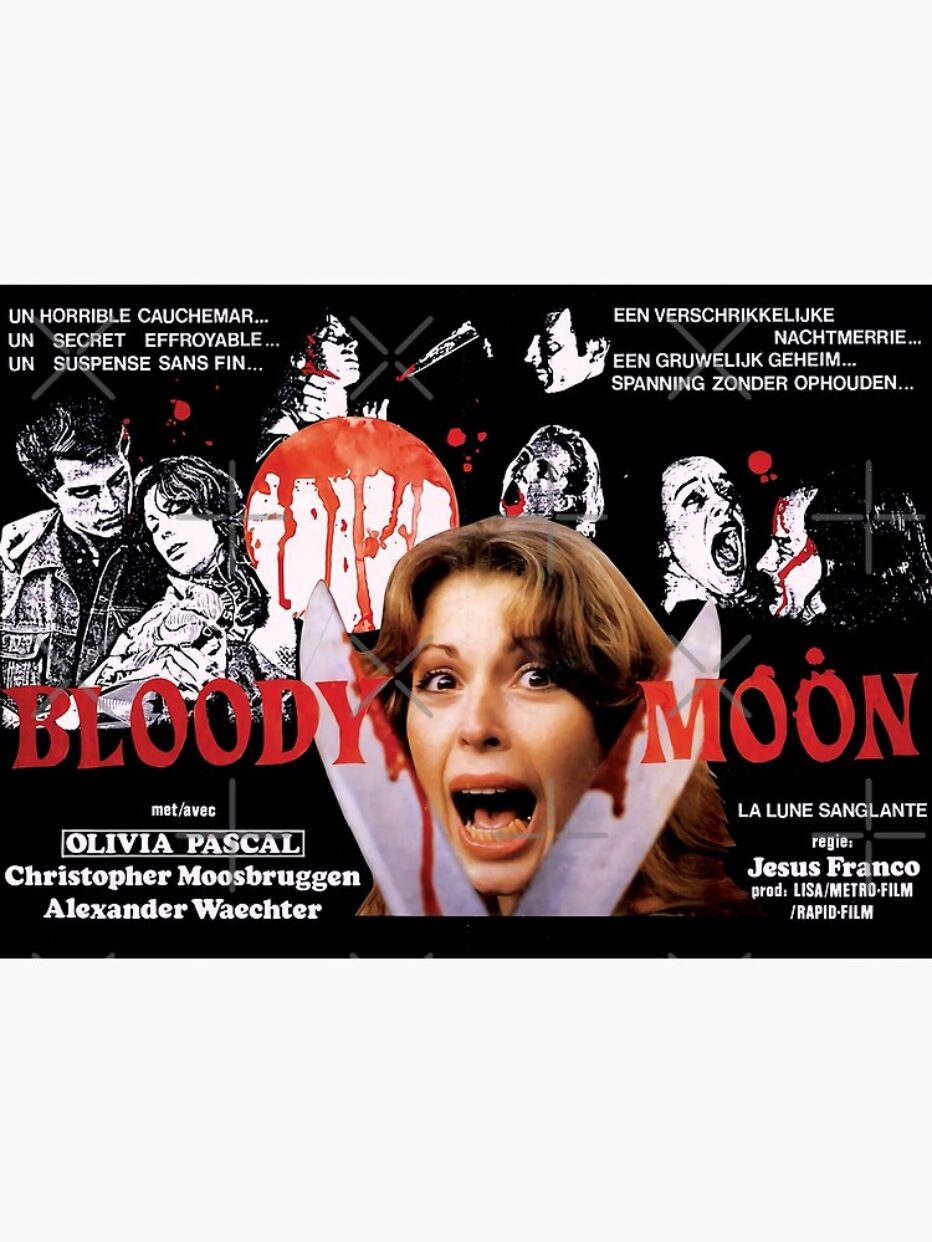
Bloody Moon (1981) Review
Bloody Moon (1981) Review
Bloody Moon is the sort of slasher that throws so many potential suspects at the audience that identifying the killer becomes less a question of deduction and more a process of elimination.
Could it be Miguel (Alexander Waechter), recently released from a five-year spell in a mental institution after murdering a girl with a pair of scissors? He certainly looks the part, sporting both a spectacularly unconvincing facial prosthetic and what can only be described as a Gary Oldman hairdo from Hell.
Or perhaps the killer is his sister Manuela (Nadja Gerganoff), who spends much of the film parading around in various states of undress while teasing her brother with the prospect of some seriously inappropriate incestuous loving, all while maintaining a relationship with language teacher Alvaro (Christoph Moosbrugger). She’s a busy girl.
Could Alvaro himself be responsible? Or perhaps young stud Antonio (Peter Exacoustos), who attracts the attention of practically every woman at the school except the one he actually wants? Maybe the whole thing is simply a figment of Angela’s imagination. Frankly, who cares? We just want to see that circular saw in action.
Directed by exploitation veteran Jesús Franco, Bloody Moon is a frankly bonkers cash-in on John Carpenter’s Halloween, with a little Psycho thrown into the mix. It may lack the craftsmanship of either, but it compensates with sleaze, outrageous set pieces and an unmistakable Euro-trash charm.
It was those set pieces that helped earn the film a place on the infamous Video Nasties list in the mid-1980s. Looking back today, it is difficult to understand quite how shocking some of the violence was considered, although several scenes remain gloriously tasteless.
There is the notorious sequence in which a woman appears to be stabbed through the back and straight out through the breast — blood on breasts being an apparent red line for the censors — followed by a wonderfully tacky decapitation involving an enormous circular stone saw. I absolutely love that fake head.
Then there is a child deliberately being run down by a car, and the splendidly gratuitous moment when a snake’s head is sliced off with garden shears, the camera lingering on the severed head as it continues to twitch. Subtle, it isn’t.
Having seen a fair number of films that once occupied the Video Nasties list, I’d put Bloody Moon firmly in the entertaining camp. The acting is hardly its strongest attribute, but that’s hardly a revelation. More surprising is that, given its notorious reputation, there isn’t actually as much gore as you might expect. Time has also been unkind to some of the effects, which now look decidedly primitive.
Yet that is part of the charm. The lurid red blood, rubbery prosthetics and obvious practical effects give the film a wonderfully grubby physicality that modern horror often lacks.
And then there is the dubbing. Oh, the dubbing.
Watching Bloody Moon transported me straight back to my younger days, when you could come home from the pub, switch on Channel 4 and discover some gloriously dubious European horror movie being broadcast in an English dub that sounded as though it had been recorded in someone’s garage. Pure Euro trash.
Franco’s exploitation credentials also mean that the women are considerably more sexually liberated than the norm for a conventional slasher. Unfortunately, they are also largely interchangeable and their dialogue frequently makes little sense unless they’re talking about sex, in which case they become remarkably enthusiastic.
It’s a bit like sharing the last bus home from Bournemouth surrounded by boozed-up chav girls — only less intimidating and, fortunately, more fully clothed.
The score by Gerhard Heinz has attracted criticism over the years. Personally, I barely noticed it, although six pints of Stella may have had something to do with that.
There is too much else going on to worry about the music anyway. The tacky early-1980s clothes and hairstyles are a delight, the club and party sequences provide an entertaining snapshot of the period, and the film seems determined to feature a full moon in practically every nighttime scene. Is it night? Put the moon in. Another night? Put the moon in again.
Franco also borrows shamelessly from Halloween. The opening adopts a camera-through-the-mask perspective, the killer has a history of being incarcerated after murdering someone with a sharp implement, and the climax features an especially blatant lift from Carpenter’s film.
When Angela discovers her friends’ corpses arranged around her apartment, the resemblance to Laurie Strode discovering the bodies of her friends in Halloween is unmistakable. The difference is that Carpenter’s sequence makes sense. Here, Angela has barricaded herself inside the apartment, so quite how the killer managed to enter, murder everyone and arrange the bodies without her noticing is anyone’s guess.
When exactly did he find the time?
Other Halloween “nods” include the killer’s institutionalisation and his dangerously close relationship with his sister. Although, to be fair, Michael Myers probably never flirted with his sibling quite like this.
The identity of the killer isn’t especially difficult to work out, despite the film throwing several suspects into the mix. Its most obvious suspect may well be the most blatant red herring in slasher history, while the eventual explanation does little to clarify a plot that was never particularly coherent in the first place.
Something may have been lost in translation. Common sense, perhaps.
Regardless, Bloody Moon is not a film to approach in search of airtight plotting or sophisticated characterisation. Its pleasures are considerably more basic: outrageous deaths, dodgy dubbing, lurid gore, questionable prosthetics, dubious sexual politics and the sheer spectacle of Jesús Franco gleefully raiding Halloween while adding his own distinctly sleazy flavour.
It isn’t good. But it is enormous fun. And sometimes that’s enough.
Bloody Moon is the cinematic equivalent of discovering something questionable on television after several pints and realising that, despite everything, you absolutely have to keep watching.
As post-pub horror fodder, it is damn near perfect. And there will always be a place for that.