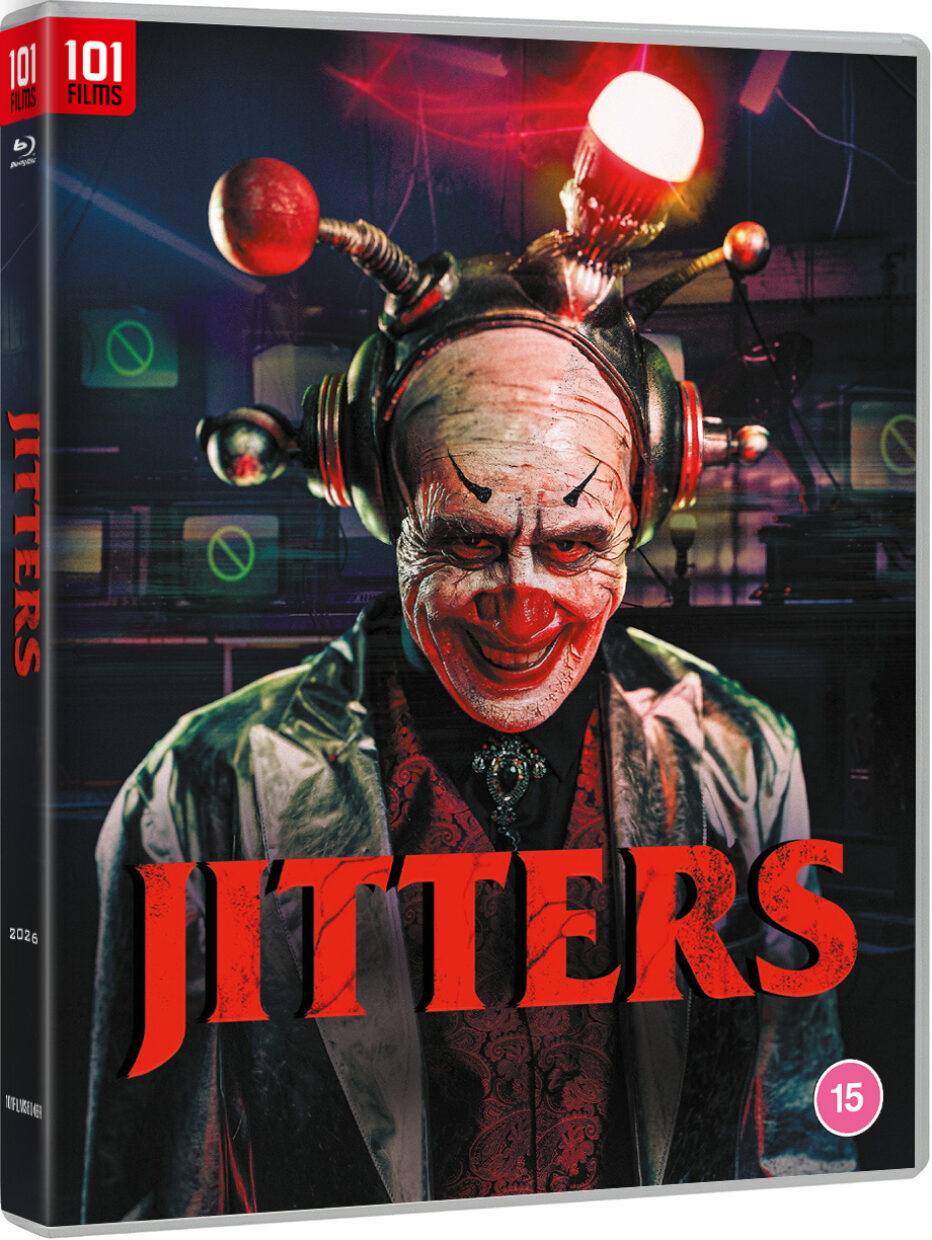
Jitters (2026) UK Retail Release Review
Jitters (2026) UK Retail Release Review
From Aptitude, the film is written by George Willcox with Marc Zammit (Witch) as director and producer, James Fuller and Richard Oakes co-produce with lead actor Fabrizio Santino (Captain America: The First Avenger, Hollyoaks), who plays the world-weary Detective Collymore. Anto Sharp (Witch) plays Detective Harding, Daniel Jordan (Palindrome) stars as Jitters and are joined by Boo Miller (Bridgerton, The Stand-Up Sketch Show), Jess Impiazzi (Keep Calm & Carry On, Celebrity Big Brother), Lauren Budd (Cinderella’s Curse), Richard Wisker (Flatmates, The Dumping Ground) Ritchi Edwards (Witch, Werwulf) and Chloe Hews (Jinx).
Long in the game Detective Collymore (Santino) thought he’d seen it all, a single father who is haunted by his own failings, he puts his all into his work. But when he’s called in to investigate what appears to be a routine case: the sudden, unexplained death of a young woman, that’s been officially ruled as “natural causes”, the detective soon finds himself faced with his strangest, most complicated case yet and is pulled deep into something truly sinister.
The complex investigation takes him not only to the dark recesses of the internet, but to the depths of his inner soul, with all clues leading to a darkly disturbing video game… Jitters – an under the radar simulation, that’s being whispered about online. But this is anything but child’s play, as the sadistic challenge weaponizes the one thing no one can truly escape: their deepest fears.
As Collymore is drawn deeper into the depths of an unknown online world, he soon learns that Jitters isn’t just depraved, it’s deadly… The only way he can survive and save his family, is to not only face the horrors coded into the system, but the darkness within himself.
Jitters begins with the promise of an intriguing horror premise but ultimately buckles beneath the weight of its own scattered ambitions. While flashes of potential emerge early on, the film struggles to sustain momentum, hampered by uneven pacing and a script that mistakes excess for depth. Dialogue-heavy scenes frequently drift between sluggish and overly indulgent, leaving the narrative feeling inert at crucial moments. By the time the credits roll, there is an overwhelming sense that too many ideas have been thrown into the mix without the necessary discipline to shape them into a coherent whole.
The film evokes echoes of classic Wes Craven territory, particularly Shocker and A Nightmare on Elm Street, both of which rooted their horror in the inescapable anxieties of everyday life. Craven’s genius lay in transforming ordinary, unavoidable experiences—electricity, sleep—into conduits of terror. Jitters attempts a similar feat, centring its horror around a memory stick that transports users into a nightmarish digital netherworld once inserted into a computer. Yet the concept falters under scrutiny. Unlike dreams or household electrical systems, the threat here feels entirely avoidable, and the film never convincingly establishes why anyone would become so compulsively drawn to the app at its centre.
This failure of motivation proves to be the screenplay’s most significant flaw. Horror depends as much on psychological plausibility as it does on atmosphere, and Jitters neglects the crucial groundwork needed to make its premise believable. Without a persuasive understanding of what compels the characters toward danger, the audience remains detached, unable to fully invest in either their choices or the consequences they face.
There is an undeniable eagerness throughout Jitters to explore a multitude of ideas, but ambition alone is not enough. Effective horror requires patience: the careful cultivation of believable stakes, emotional investment, and internal logic. Unfortunately, the film rushes past these essentials, leaving behind a work that feels underdeveloped and ultimately unconvincing. Despite moments of promise, Jitters never fully earns its horrors, resulting in a film that frustrates more than it unsettles.