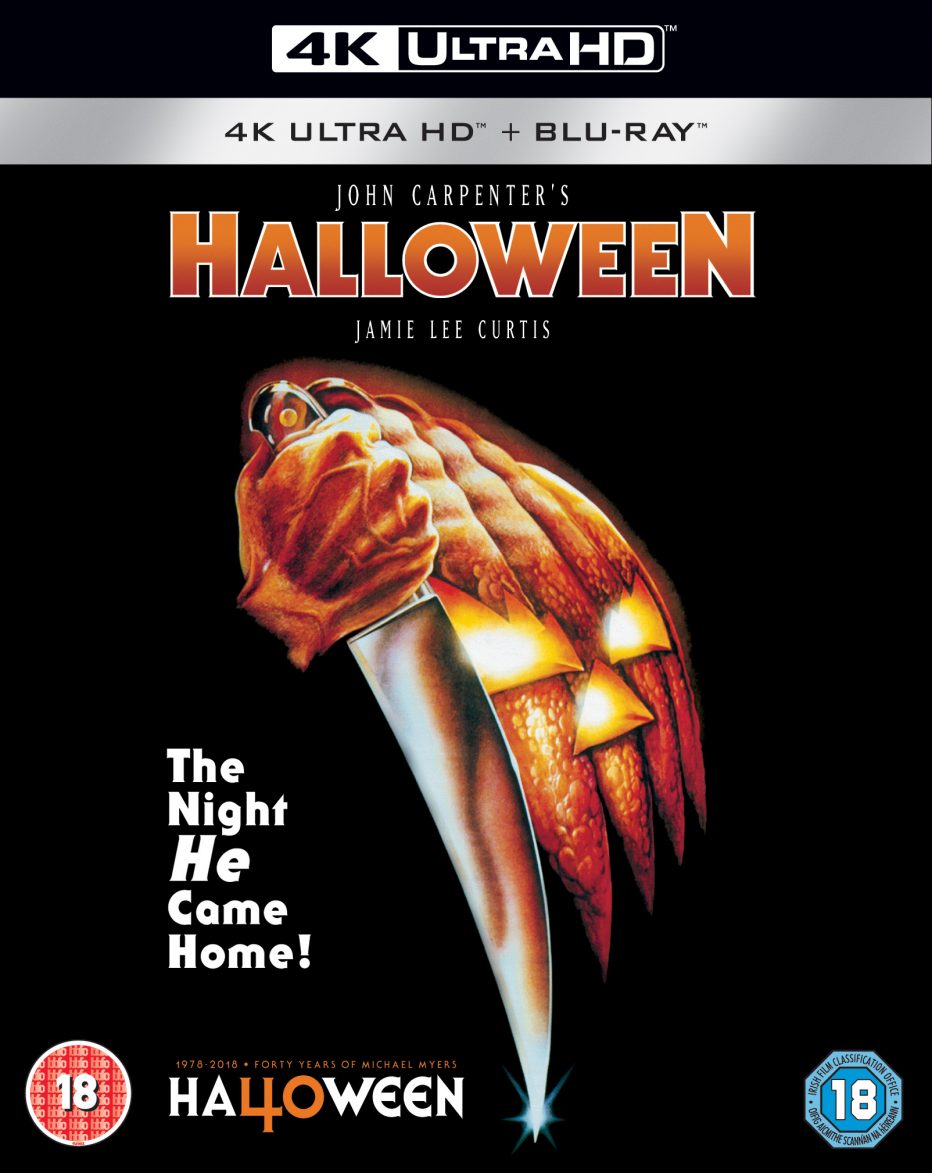
Halloween (1978) Review 4K Ultra HD Edition
Halloween (1978) Review
When the remake of Bob Clark’s Black Christmas was being primed for the big screen, an interview with the late Canadian director shed light on an interesting story pertaining to the origins of Carpenter’s Halloween. Bob Clark mentioned that had started work on a movie with John Carpenter for Warner Bros. and was asked by the maverick director if he was ever going to do a sequel to his festive themed cult horror hit. Clark said no, that he was through with horror. Carpenter persisted with his questioning. He wanted to know that if Clark ever did a sequel, what the story might have been. Off the cuff Clark said that it would probably take place in the next year with Billy having been caught by the authorities. Billy would then escape from his incarceration, in a mental institution, and return to the sorority house where he would recommence killing. Clark told Carpenter that he would probably call it Halloween.
When John Carpenter was championing his intense police drama Assault on Precinct 13 (1976), which went down a wow at that year’s London Film Festival, he met producer Mustapha Akkad. Carpenter told Akkad of an idea he had for his next picture. He was going to call it The Babysitter Murders. Akkad liked the sound of it and saw it as his entry into the American film market but he suggested that the title be changed to Halloween.
Along with his then girlfriend, the now departed Debra Hill; Carpenter tweaked and adjusted his story to fit around the events of a standard October 31st. With Hill’s home town being Haddonfield, in Illinois, they decided to set the story there. Tying into the Festival of Samhain, Carpenter and Hill wrote about an evil that could not be destroyed, returning to his home town to spend his birthday slicing up his old neighbours. Dispensing with the idea of putting as much blood and guts as they could in the script they opted for ‘boo’ moments instead to elicit a response from the audience. Within three weeks the script was ready.
In naming the characters they drew from a number of sources. For the manic pursuer of Michael Myers – Dr. Sam Loomis (Donald Pleasance) – they named the character after John Gavin’s in Hitchcock’s classic Psycho (1960). As for the name Michael Myers that was Carpenter’s way of saying thank-you to the same-named distributor of Assault on Precinct 13 for the success the film enjoyed outside of the US. Laurie Strode (Jamie Lee Curtis) was the name of Carpenter’s first girlfriend and the young boy she babysits – Tommy Doyle (Brian Andrews) – was named after a character in Hitchcock’s Rear Window (1954).
The Hitchcock references do not end there. The most obvious reference is in the casting of Jamie Lee Curtis. Miss Curtis is the daughter of Janet Leigh who played Marion Crane in Hitchcock’s infamous Psycho (1960), who famously got sliced and diced in THAT shower scene. Apparently Miss Curtis was not the first choice for the role of Laurie but rather an actress by the name of Annie Lockhart. That all changed when Carpenter realized the publicity Curtis’ connection to Psycho would bring to his film. It is said that the opening murder, as a young Michael wanders up the stairs – dressed as a clown and armed with a knife – to kill his older sister is also a homage to Psycho. In the shot where Michael stabs his sister we never ever see the knife penetrate her skin, much like the shower scene in Hitchcock’s movie.
Halloween was shot in just twenty one days during the spring of 1978. To give the impression that it was October, paper leaves were bought and painted in autumnal colours. After being flung in front of the camera, for filming purposes, they were then raked up and used again for other shots later. With a budget of just $300,000, (half of which was spent on the Panavision cameras) the movie went on to gross an estimated $55million in the States and launch a franchise that is still alive and well, forty years later.
Carpenter received $10,000 to write, direct and provide a soundtrack – and what a score he went on to deliver – as well as 10% of the film’s eventual profit. Halloween went on to become the highest-grossing independent movie of all-time after opening slowly and generating terrific word of mouth. In fact the budget was so tight that most of the actors wore their own clothes as there was no costume department. Jamie Lee Curtis ended up shopping at J.C. Penney for Laurie’s outfits. Myers’ iconic mask came courtesy of Carpenter’s long-time friend Tommy Lee Wallace and was actually a Captain Kirk mask he’d purchased for just $1.98. They spray-painted the face white, adjusted the eye-holes and hey Presto, one horror icon created!
In much the same way that Bernard Hermann’s score for Psycho (1960) impacted on audiences, John Carpenter’s synthesized score for Halloween also struck a nerve and is now widely considered one of the best scores for a genre movie. Credited to the non-existent Bowling Green Philharmonic the music came courtesy of the director, who had previously and effectively scored Assault on Precinct 13 before going on to score many of his others.
Opening in Halloween 1963, we watch events unfold from the killer’s point of view as a young woman, the killer’s sister, and her boyfriend canoodle downstairs. They disappear upstairs for the quickest shag ever in cinematic history. After his sister’s lover leaves, young Michael wanders up and stabs his sister to death. This tracking shot looks like one single tracking shot but is actually done in three cuts – the first cut is when Michael has put on the mask and the next two cuts are there to accelerate the action after the murder. As the young actor was unavailable for these shots the hands you see holding the knife are actually Debra Hill’s.
Michael’s parents arrive back home and catch their son as he hurries outside carrying a huge bloodied knife in his hand. Next we jump forward to 1978 where Doctor Sam Loomis (played by Pleasance after both Peter Cushing and Christopher Lee turned down the role) is identified as having been Michael’s doctor since the stabbing got him incarcerated. Michael escapes from the facility one stormy night, by stealing the doctor’s car.
Soon Michael is driving around his old home town and taking up residence in his former home, now disused, where he spies on the locals and treats himself to the occasional dog to eat for sustenance. We meet young Laurie, who is quickly established as the more responsible of her buddies, which includes pot-smoking cop’s daughter Annie (Carpenter regular Nancy Kyles) and Lynda (P.J. Soles, who played a similar character in 1976’s Carrie) who says ‘Totally’ so often that you desperately want her totalled and soon too! Laurie is going to be babysitting across the road from her friend Annie for the evening, so they keep in touch by phone, all the while they are being watched from outside by Michael who is just looking for the right moment to kill them and use them as part of his shrine to his dearly departed older sister in the upstairs bedroom.
After building up to such a crescendo, the movie couldn’t just end with Michael being floored by a measly knitting needle in the neck, courtesy of Laurie, so Carpenter had him get up again, and again, and again. ‘You can’t kill the boogeyman!’ says young Tommy by way of explanation. Kid, he’s just a man, you should be able to kill him! In an otherwise excellent sleek fright machine of a movie the surprise ending is the only false note. Like Stephen King, Carpenter can spin out a great tale but never knows quite how to finish them but don’t let my little niggle with one plot point sway you away from this classic slasher. John Carpenter’s Halloween was the film that lit up my love for the genre – as one of the first video cassettes my dad rented many years ago – and it’s a film that I have revisited many, many times and have never grown tired off. I fall in love with it again as soon as the first beats of the iconic score kick in, always have and always will.