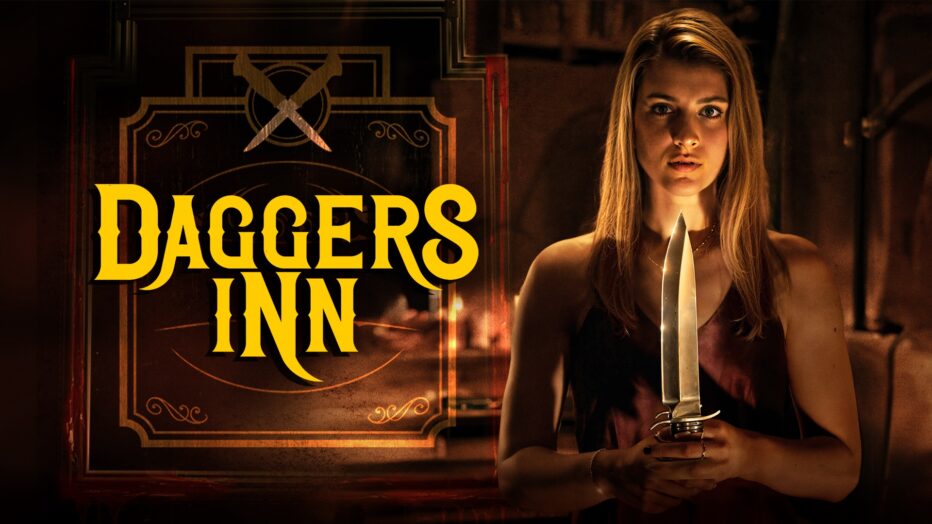
Daggers Inn (2025) Review
Daggers Inn (2025) Review
When the enigmatic Donna Revan (Anna Danvers) arrives in the mediaeval village of Haxanbury, little do the locals realise that she is visiting with a sinister ulterior motive… revenge. Two years ago, the body of her sister, Sybil, was mysteriously discovered floating in the local lake with her hands and feet bound to a chair. Now, the determined Donna has arrived to infiltrate the dark workings of the townsfolk, digging up their darkest secrets to try and uncover what really happened.
Micro-budget filmmaking often thrives on atmosphere and ingenuity, and the latest feature from husband-and-wife team James Smith and Caroline Spence aims to do just that. Following their previous collaborations Best Geezer and Casting Kill, the duo return with Daggers Inn, a moody rural mystery that recently played the festival circuit ahead of its UK digital release on 23 March via Seven Tales.
The film stars Anna Danvers as Donna Revan, a determined young woman who arrives in the picturesque yet eerily quiet village of Haxanbury to investigate the murder of her sister. The settlement appears almost abandoned, populated only by a handful of key figures whose unease grows quickly after Donna’s arrival. Her sister, the audience learns, was murdered and dumped in a lake by individuals linked to the town’s law firm—an organisation now keen to ensure Donna’s investigation goes no further.
Donna takes up residence at the ominously named Daggers Inn, a location the locals seem to fear. Throughout the story she displays subtle, witch-like abilities, though the film deliberately keeps the supernatural elements ambiguous. The suggestion of occult forces adds intrigue, but the narrative largely avoids exploring them outright, opting instead for a restrained tone that may leave viewers wishing the film had leaned further into its darker mythology—especially given the village’s suggestive name, Haxanbury.
Smith’s cinematography is crisp and clean, making the most of the film’s limited locations. However, the visual style rarely evolves, and repeated framing of the same settings can make the film feel static. The sense of isolation is effective, but the restricted geography also creates an unintended claustrophobia that underscores the story’s limited momentum.
Much of the runtime is devoted to conversations among the antagonists, who repeatedly discuss their need to eliminate Donna but delay taking decisive action until the closing stretch. This emphasis on dialogue over plot development slows the pacing considerably. While the script is peppered with sharp barbs and witty exchanges, the narrative itself struggles to build urgency or surprise.
Performance-wise, the cast acquit themselves well. Danvers brings quiet resolve to Donna, while the supporting villains provide some of the film’s liveliest moments—particularly the contrasting henchmen played by David J Biscoe and David Streames, whose bumbling and menace create an engaging dynamic.
Ultimately, Daggers Inn succeeds in establishing a brooding atmosphere but falters in delivering a compelling mystery. The culprit behind the sister’s murder becomes fairly obvious early on, undercutting any genuine “whodunnit” intrigue. With stronger pacing and a bolder embrace of its supernatural hints, the film might have transformed its eerie setting into something far more memorable.
Daggers Inn on digital 23 March from Seven Tales
Trailer