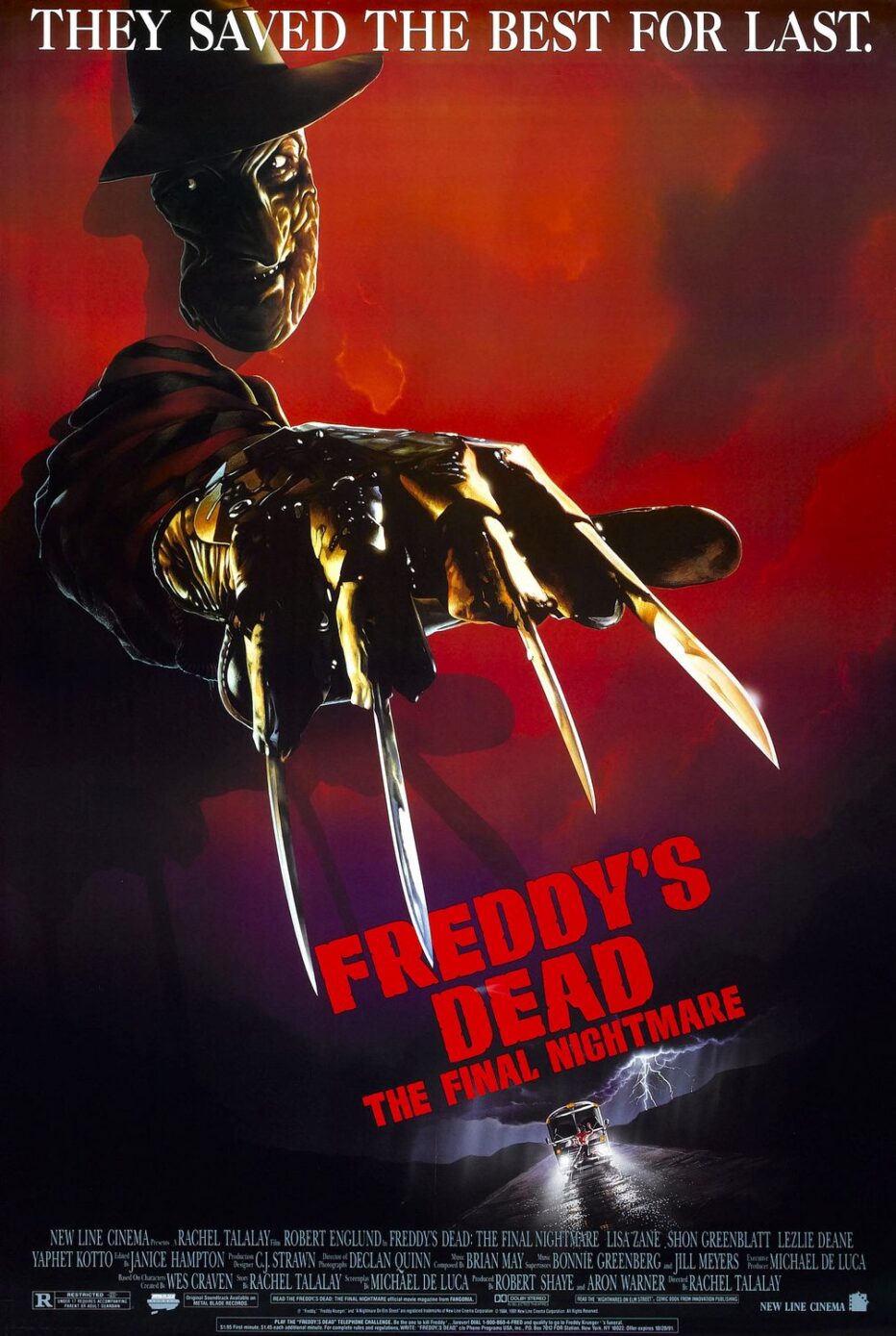
Freddy’s Dead: The Final Nightmare (1991) Review
Freddy’s Dead: The Final Nightmare (1991) Review
As the promotional posters proudly proclaimed upon its release, serial child killer Freddy Krueger was finally set to meet his maker on September 13, 1991. Of course, anyone familiar with the horror business knows that death is rarely a permanent condition for a successful slasher villain. Freddy does indeed blow up at the end of the movie, but this proved to be little more than a rather cheeky bluff. With a production budget of around $5 million and a US box-office haul of approximately $35 million, there was absolutely no way New Line Cinema’s Bob Shaye, who even makes a cameo appearance as a ticket seller near the beginning, was going to let his lucrative franchise die without a fight.
And so, despite that supposedly definitive title, Freddy Krueger would live to slash another day.
Freddy’s Dead: The Final Nightmare gets off to a promising start, taking the time to establish its characters and provide a reasonably coherent, if hardly groundbreaking, plot around which to build the carnage. We discover that, before being burned alive by the enraged parents of Springwood, Freddy may actually have fathered a child. The question is whether the young lad who turns up at a youth hostel is the offspring in question, or whether the answer lies with Maggie Burroughs, one of the therapists working there. Naturally, Freddy has a few ideas of his own about how this little family mystery should be resolved.
With a story by director Rachel Talalay, who would later go on to helm the gloriously bonkers Tank Girl (1995), the sixth instalment in the A Nightmare on Elm Street franchise proves to be a thoroughly entertaining affair. It may not possess the ingenuity of Wes Craven’s original, but by this stage the series had developed its own peculiar blend of nightmare imagery, black comedy and outrageous set pieces. Freddy’s Dead embraces all three, delivering a suitably theatrical send-off for its razor-gloved antagonist.
The film’s biggest selling point, however, is its climactic 3D showdown. Released during the early-Nineties revival of the format, it could easily have fallen into the same trap as Friday the 13th Part III (1982) and Jaws 3-D (1983), with objects repeatedly thrust towards the camera simply to justify the price of the glasses. Thankfully, Freddy’s Dead is rather more imaginative.
Here, the 3D glasses are incorporated into the story itself, becoming a means of seeing Freddy’s world rather than merely a gimmick designed to make the audience duck for cover. The effects are impressive, adding a suitably surreal dimension to the final confrontation. Better still, the sequences remain surprisingly effective even when viewed in flat 2D, with the visual tricks generally retaining their impact rather than looking like scenes that only make sense when viewed through special spectacles. It’s a clever approach that gives the finale a genuine sense of occasion.
The film also benefits from a handful of amusing cameos, including Johnny Depp, Alice Cooper and Roseanne Barr, adding to the sense that everyone involved is having a bit of fun before the nightmare supposedly ends. There’s an almost celebratory atmosphere to proceedings, as though the filmmakers know they’re dealing with a franchise that has become an institution and are determined to give audiences one last suitably extravagant ride.
And that brings me to the theatrical experience itself. When I saw Freddy’s Dead during its opening weekend, the cinema had a genuine party atmosphere. The audience was thoroughly invested, reacting to the gags, the kills and the 3D effects with an enthusiasm that transformed the screening into an event. You don’t often get that sort of communal excitement, even with original films, let alone the sixth entry in a long-running horror franchise.
Of course, the promise that this would be Freddy’s final outing was never particularly convincing, especially with those box-office figures. But as sequels go, Freddy’s Dead: The Final Nightmare is a good deal more enjoyable than its reputation might suggest. It delivers a colourful, occasionally daft and frequently inventive slice of horror entertainment, capped by a memorable 3D finale that gives the film a distinctive identity.
Freddy may have been destined to return, but for a supposedly final nightmare, this one certainly knows how to send an audience home smiling.