


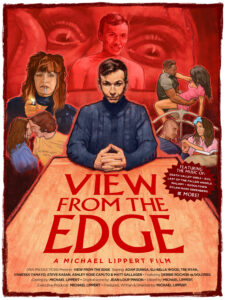
View from the Edge (2025) Review
The film follows three couples who spend the weekend at the lake-front cottage of Charles F. Benjamin, a very peculiar man they meet at an online event. As the weekend unfolds, drugs, sex and intimate fears guide the outcomes of their individual journeys as their host grows increasingly sinister and deranged.
There’s an interesting idea at the core of Michael Lippert’s View from the Edge, but it only truly comes to life in the second half—quite literally, as the film pauses for a ten-minute interval midway through.
The first half proves a slog. We are introduced to three married couples and their uneasy host, the distinctly Norman Bates-like Charles F. Benjamin (Matt Gallagher), but the setup drags under the weight of static camerawork and lifeless, overly extended dialogue. Scenes linger without purpose, offering little in the way of tension, intrigue, or narrative momentum. Crucially, there’s no real hook—nothing to invest the viewer in where the story might be heading.
Lippert’s intention is clear: to create a horror film that prioritises character development over body count, so that when violence does arrive, it carries emotional weight. It’s an admirable goal, but one that falters in execution. The characterisation is too thin to support that ambition, and the couples themselves prove more grating than engaging. As a result, when the film shifts gears and the killings begin, the reaction is less shock or sadness and more relief.
The film also struggles with basic logic. Each couple openly acknowledges how unsettling Charles is, even going so far as to suggest he could be dangerous. Yet, despite these collective alarm bells, they willingly agree to spend a weekend at his isolated lakeside cottage. It’s a decision that stretches credibility to breaking point. Similarly, the implication that Charles repeatedly finds victims at the same type of event without raising suspicion feels implausible—surely such a pattern would not go unnoticed.
To its credit, the second half is a marked improvement. Once the horror elements take centre stage, the film finds a stronger rhythm and a clearer sense of purpose. While still far from perfect, it is notably more confident and, at times, genuinely entertaining—particularly as the body count rises and the film embraces its darker instincts.
Shot independently over just two weeks in Canada on a shoestring budget, View from the Edge is undeniably a product of passion, and the effort of those involved is evident. However, its two-hour runtime (including the interval) is excessive, with the first half in particular crying out for significant trimming. Prolonged dialogue scenes and indulgent moments—such as an unnecessary eating montage filled with close-ups—only serve to further stall the pacing.
Genre fans may be intrigued by voice contributions from horror veterans John A. Russo, Brinke Stevens, and Lloyd Kaufman. Unfortunately, their inclusion results in one of the film’s more distracting sequences, as the sound mix favours their voices over the on-screen actors, creating a muddled and often unintelligible exchange.
The decision to include outtakes over the end credits is another curious choice. While such additions are commonplace in comedies, they feel tonally out of place here, reinforcing a sense of uncertainty about what the film ultimately wants to be. If View from the Edge is aiming for humour alongside its horror, it largely misses the mark.
In the end, View from the Edge is a film of two uneven halves: a laborious and unfocused opening followed by a more engaging, if still flawed, descent into horror.
There are glimpses of a stronger film within it, but they arrive too late to fully redeem the experience.