


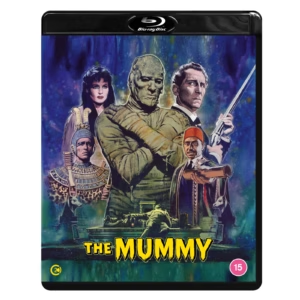
The Mummy (1959) Standard Edition Blu-Ray Review
The Mummy sees Cushing give a haunting turn as an Egyptologist who discovers an ancient tomb and inadvertently unleashes the vengeful mummy of an Egyptian priest played by horror legend, Christopher Lee (Dracula, The Wicker Man, The Lord of The Rings).
In 1890s Egypt, a team of British archaeologists: John Banning (Cushing), his father Stephen Banning (Felix Aylmer), and Uncle Joseph Whemple (Raymond Huntley), discover the untouched tomb of Princess Ananka (Yvonne Furneaux). Inside the tomb, Peter discovers The Scroll of Life and, when he reads it aloud, he unknowingly brings the mummified body of the high priest Kharis (Lee) back to life…
Three years later and the group have returned to England, unaware of the nefarious consequences of their actions. A follower of the same Egyptian religion unleashes The Mummy to exact grisly revenge on the despoilers of the sacred past. As the creature edges nearer to exact its revenge, can anything save them from its relentlessly vicious and vengeful mission?
Directed by Terence Fisher, 1959’s The Mummy stands as a curious blend of homage and reinvention, emerging at the height of Hammer Film Productions’ gothic horror cycle. Written by Jimmy Sangster, the film draws clear structural inspiration from Dracula—most notably in its narrative framework, where an ancient, foreign evil intrudes upon English soil, precipitating both terror and psychological collapse. This descent into instability is embodied by the unfortunate Stephen Banning, whose fate culminates in confinement within a “nursing home for the mentally disordered,” not unlike Renfield in Bram Stoker’s classic vampire tale.
Despite sharing its title with The Mummy, Hammer’s version is less a direct remake than a reinterpretation. It borrows selectively from Universal Pictures’ earlier cycle—most notably the name Kharis, which does not appear in the 1932 original but features prominently in its sequels—while forging its own distinct identity.
At its core, the film benefits from the formidable presence of Christopher Lee as Kharis. Opposite him, his frequent co-star Peter Cushing delivers a performance marked by his customary precision and restraint. Lee, largely silent throughout, relies on an imposing physicality to convey menace, with particular emphasis on his expressive gaze, which proves more evocative than dialogue could achieve.
Visually, the film exemplifies Hammer’s signature aesthetic: richly saturated colour palettes and a heightened sense of the macabre. Notably, certain sequences—particularly Kharis’s mutilation and violent demise—were originally filmed with greater graphic intensity before being curtailed by British censors, reflecting the shifting boundaries of screen horror in the late 1950s.
For all its atmospheric strengths, however, the film struggles to sustain narrative momentum. Sangster’s script often proves overly verbose, substituting exposition for action, and the relative lack of dynamic incident leads to a perceptible sag in the latter half. Performances, while competent, occasionally verge on stiffness, diminishing the emotional immediacy of the drama.
Nevertheless, the film’s legacy endures. It has been cited as an influence on the Doctor Who serial The Pyramids of Mars, underscoring its lasting imprint on British genre storytelling. With the mummy myth continuing to resurface in contemporary cinema, Hammer’s 1959 effort remains a noteworthy—if imperfect—artifact, capturing both the ambition and the limitations of its era.
EXTRAS
Special Features
Main feature presented in original UK theatrical aspect ratio 1.66:1 and alternative full frame1.37:1
New audio commentary by film academic Kelly Robinson
Archive audio commentary by Marcus Hearn and Jonathan Rigby
An Appreciation of The Mummy by David Huckvale
The Music of The Mummy
Unwrapping The Mummy
The House of Horror: Memories of Bray
The Hammer Rep Company
Original Promo Reel
Still Gallery