


Electric Meat (2026) Review
Electric Meat is set for its World Premiere at Tubi FrightFest on 28th August. Directed by comic book artist and writer, Dan Schaffer (The Scribbler, Doghouse, Peripheral), the psychosexual thriller stars Caspian Faye (Cat Skin), Emily Booth (Doghouse, Evil Aliens) and Nina Courson.
A photographer working a day job as a butcher finds one of his models murdered in an alley and being comfortable around dead meat, decides to keep her around as his muse to help his failing career.
But he becomes convinced that she is somehow both alive and dead, like Schrödinger’s cat. And she’s rebelling! Changing from a posable doll to a vengeful revenant.
As the Butcher’s source of inspiration becomes his darkest fear, he turns to his landlady, an ex-model with a grudge. She’s dangerous, unhinged, and ready to take his work in a whole new psychotic direction.
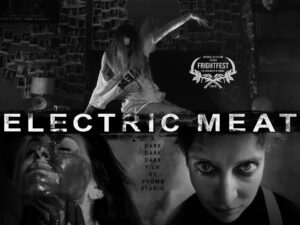
Electric Meat is a strikingly atmospheric piece of filmmaking, one that places considerably more emphasis on imagery, sound and mood than conventional narrative. Shot in evocative black and white, the film embraces a largely non-verbal approach to storytelling, allowing its visuals and soundscape to communicate much of what the characters and narrative leave unsaid. There are moments when the film’s unsettling sonic textures recall the work of David Lynch, particularly his earlier films, creating an appropriately disquieting atmosphere.
Caspian Faye plays a failed artist who supplements his income by working as a butcher during the day. When he discovers the body of one of his models in an alley, he decides to use the corpse as a new muse for his art. Unfortunately for him, this particular muse has other ideas. What follows is an increasingly threatening situation that puts his safety and well-being at risk, particularly when another muse enters the picture.
Visually, Electric Meat is undeniably impressive. Director and cinematographer demonstrate a clear understanding of composition, with virtually every frame possessing an artistic quality of its own. The black-and-white photography gives the film a suitably bleak and nightmarish aesthetic, while the sound design adds another layer of unease. The film frequently communicates through suggestion rather than exposition, trusting its audience to interpret what they are seeing and hearing.
This makes Electric Meat particularly well suited to the film-festival circuit, where its experimental and arthouse sensibilities are likely to find a more receptive audience than they might within the mainstream. It is certainly a film that has something to say visually, even if what it has to say narratively is rather less substantial.
And therein lies my principal reservation. As much as I admired the film’s aesthetic, I found myself wishing there was more substance beneath those impressive visuals. The story is constructed from decidedly minimal ingredients, and while that sparseness initially works in the film’s favour, the effect begins to wear thin as it progresses. I wanted to become more invested in the characters and the unfolding narrative but ultimately felt that there simply wasn’t enough meat on the story’s bare bones.
I came away from Electric Meat appreciating considerably more about how it looks and sounds than what it ultimately has to say. There is some genuinely inventive filmmaking here, and the imagery and soundscape are often excellent, but I couldn’t help feeling that the concept might have been better suited to a short story rather than a feature-length film.
I really wanted to like Electric Meat more than I did. Nevertheless, its striking monochrome photography, experimental approach and constantly inventive visuals make it an intriguing piece of cinema, particularly for those who enjoy films that place atmosphere and visual storytelling ahead of conventional narrative.